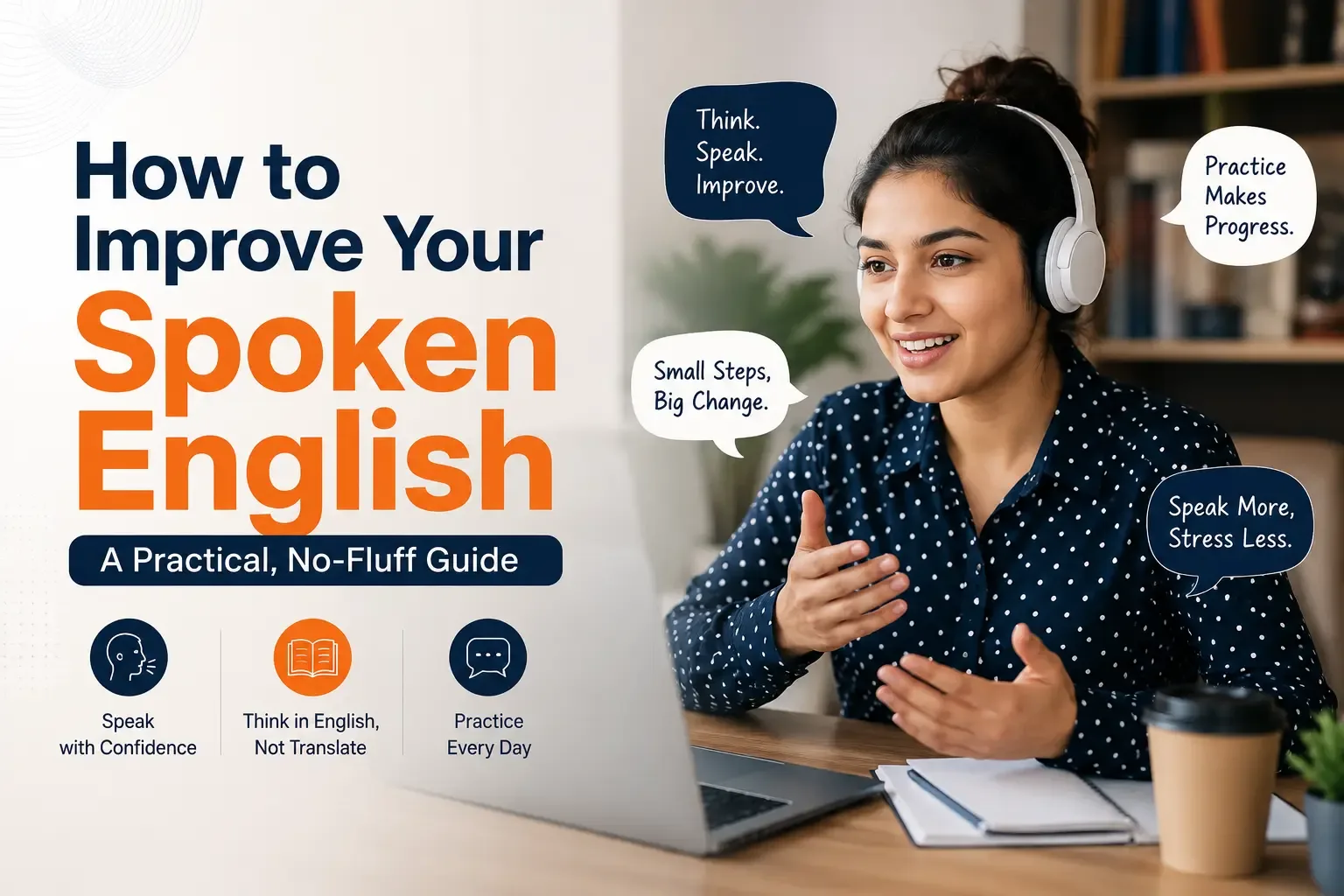

You can spot the mistake in someone else's sentence in half a second. You know when to use "since" instead of "for." You've read enough English to write a decent email without breaking a sweat. And then someone asks you a real question, in real time, and your mind goes blank or you start talking and the words come out slow, tangled, and nothing like what you rehearsed in your head a second ago.
If that sounds familiar, you're not bad at English. You're bad at speaking it which is a completely different skill, and almost nobody tells you that.
That gap between what you know on paper and what you can actually say out loud is what people mean when they talk about spoken English. It's not a smaller version of "real" English. It's its own skill, with its own rules, and it responds to a completely different kind of practice than the one most of us grew up doing in school.
This guide covers why that gap exists, what actually closes it (not the vague "just practice more" advice), how long it realistically takes, and how to tell whether you can get there on your own or need more structured help.
Quick answer: Spoken English improves through daily active speaking practice, not more grammar study. The fastest gains come from thinking in English instead of translating, shadowing natural speech out loud, and getting feedback on your specific mistakes from another person, since most of them are impossible to catch on your own. Most consistent learners feel a real difference within a few months not days, whatever a course advertisement promises.
Spoken English vs. Written English: Why They Feel Like Different Languages
When you write, you get time. You can pause mid-sentence, delete a word, rearrange a clause, look something up. Nobody's watching the clock.
Speaking doesn't give you that. You get maybe half a second before a pause starts to feel awkward. You have to retrieve words, build a sentence, and say it all at once, all in real time, usually while someone is also waiting for your answer or already forming their next question. There's no undo button.
Most of us especially anyone who went through the Indian school system spent years on English as a written subject. Grammar rules, comprehension passages, essay structure, spelling. All useful, none of it rehearsed out loud under time pressure. So you end up with a strange result: someone who can write a grammatically flawless paragraph but freezes when asked to introduce themselves at a job interview.
That's not a contradiction. It's just two different skills that happened to share a vocabulary.
Why Knowing the Rules Doesn't Mean You Can Speak Fluently
Here's what's usually happening in that pause before you answer: you're not thinking in English. You're thinking in your first language, translating it in your head, checking the grammar, and only then saying it all before you've spoken a word. That process is slow, and it shows.
It also produces very specific, very recognizable patterns. If you've ever said "I am having a doubt" instead of "I have a doubt," or "revert back to you" instead of just "revert," or "do the needful" you've felt this firsthand. These aren't wrong exactly. They're direct translations of how the thought is structured in Hindi, Tamil, Bengali, or whichever language you're translating from. The grammar checks out. It just isn't how a fluent speaker would build the sentence in real time.
The other piece is simpler and more human: fear of sounding wrong. Most people who struggle with spoken English aren't actually short on vocabulary they're short on a place to make mistakes without feeling judged for their accent, their pace, or their word choice. And if you never get that low-stakes practice space, the fear doesn't go away on its own. It just gets reinforced every time you avoid speaking.
Do You Need to "Fix" Your Accent?
Short answer: no but you probably need to fix your clarity, and people often confuse the two.
An accent is just the sound of where you learned English and which languages shaped your ear before that. It's not an error. Plenty of fluent speakers Indian, Nigerian, Filipino, Irish, Scottish sound nothing like a news anchor from London or New York and communicate perfectly well. There isn't one "correct" accent that spoken English is supposed to sound like.
What actually causes confusion isn't accent it's clarity. Sounds getting merged (v and w, or short vowel sounds that collapse into each other), word stress landing on the wrong syllable, or speaking so fast that consonants get swallowed. Those are the things that make someone ask you to repeat yourself, not the accent itself.
So if you're chasing a "neutral" or American-sounding accent because you think that's what fluency requires, you're solving the wrong problem. Work on pacing, on stressing the right syllable in longer words, on pronouncing the ends of words instead of trailing off and let your accent stay exactly what it is. Confidence carries a conversation much further than a borrowed accent ever will.
What Actually Improves Spoken English
Not tips you've heard a hundred times the specific habits that make a measurable difference.
Stop Translating in Your Head
The single biggest shift is learning to think in English for small, everyday things not big philosophical thoughts, just narrating what you're doing. "I'm making tea." "I need to leave in ten minutes." "This bag is heavier than I expected." Do this in your head while you're doing chores, commuting, waiting in line. You're not learning new grammar here you're building the habit of forming English sentences without a translation step in between, which is the actual bottleneck for most learners.
Shadow Real Speech, Don't Just Listen to It
Passive listening podcasts in the background, English news on mute barely moves the needle. Shadowing does. Pick a short clip, 30 to 60 seconds, of someone speaking naturally, play a line, pause, and repeat it out loud, matching their rhythm and stress, not just the words. It feels awkward for the first few tries. It's also one of the fastest ways to fix flat, robotic-sounding English, because you're training your mouth and ear together instead of just your vocabulary.
Change What You're Watching and Listening To
This one's simple, and most people skip it anyway. If your shows are dubbed, switch the audio to English. If you're watching with subtitles in your own language, switch them to English subtitles first, then try turning subtitles off for scenes you already know well. You're not doing this to "study" you're doing it so your ear gets hundreds of hours of natural rhythm, slang, and sentence pace without it feeling like effort. Most fluent non-native speakers didn't get there by studying harder. They got there by spending more hours inside the language doing things they'd have done anyway.
Speak Every Day, Even Badly
Twenty minutes of speaking daily beats a two-hour session once a week, every time. Talk to yourself if you have to describe your day, argue both sides of a small decision, explain something you learned. The content doesn't matter much. What matters is that your brain gets daily reps at producing English in real time, which is the exact skill you're trying to build.
Record Yourself and Actually Listen Back
Uncomfortable, and worth doing anyway. Record two minutes of yourself talking about anything, then play it back. You'll hear filler words you didn't know you used, a pace that's faster or slower than you thought, and mistakes that completely disappear while you're mid-conversation but jump out the second you're just listening. This is one of the only ways to catch errors your own ear has gotten used to ignoring.
Learn Phrases, Not Just Words
Memorizing vocabulary lists gives you bricks with no way to lay them quickly. Learning full chunks "make a decision," "as far as I know," "get in touch with," "I couldn't agree more" gives you pre-built pieces you can drop into a sentence without constructing it word by word under pressure. Fluent speakers aren't assembling every sentence from scratch. They're reusing chunks they've said a hundred times before.
Fix One Mistake at a Time
Trying to fix your grammar, pronunciation, vocabulary, and pace all at once is exactly why most people give up after two weeks. Pick one recurring error maybe it's mixing up "he go" and "he goes," maybe it's dropping articles, maybe it's a specific sound you can't quite place and focus only on catching that for a couple of weeks before you add the next one. Fluency is built error by error, not in one sweeping correction.
How Long Does This Actually Take?
Longer than a 30-day course promises, and less time than fear tells you.
There's no universal number, because it depends on where you're starting, how much English you're already exposed to, and more than anything how consistent your practice is. Someone speaking for twenty focused minutes a day will noticeably outpace someone doing an occasional two-hour session on weekends, even if the second person is putting in more total time over a month.
For a rough anchor: Cambridge English, whose CEFR levels most structured courses are benchmarked against, estimates it takes 100 to 200 hours of guided learning to move up one level, with the number climbing as you go higher. That puts going from near-zero to full fluency somewhere around 1,000 to 1,200 hours of structured learning in total. That figure covers overall language study, not speaking practice alone, but it's a fair gut-check against anyone promising fluency in a few weeks.
Here's what tends to happen in practice: the first few weeks feel like nothing is changing, because fluency doesn't show up gradually and evenly. It shows up in small jumps, usually right after you've pushed through an uncomfortable conversation. A few months of genuinely consistent practice is enough for most people to notice a real, felt difference in how it feels to speak. Full comfort the kind where you're not translating or rehearsing in your head at all takes longer, and honestly keeps improving with use for years.
Be skeptical of anyone promising fluency on a fixed short timeline. Comfort with a language doesn't work like a certification you unlock.
When Self-Study Hits a Wall
Everything above works, and it has a ceiling not because the techniques stop being useful, but because of three things you genuinely can't do alone.
You can't reliably hear your own mistakes. Your ear adjusts to your own errors faster than you'd think, which is why the same grammar mistake can slip past you for years even while you'd catch it instantly in someone else's sentence.
You don't get real conversational pressure. Talking to yourself builds fluency, but it doesn't train you for the unpredictability of a real exchange someone interrupting, asking a follow-up you didn't expect, disagreeing with you. That's a different muscle entirely.
And you lose structure. Without someone checking in, "I'll practice daily" quietly turns into "I'll practice when I remember," which is most people's actual experience with self-study, whether they'd admit it or not.
None of that means self-study doesn't work. It means it works right up until the point where you need another person a teacher, a fluent friend, a structured class to catch what you can't catch yourself and keep you showing up consistently.
If You're Looking at Spoken English Classes, Here's What Actually Matters
Not every class labeled "spoken English" delivers the same thing. A lot of them are grammar classes wearing a different name. Before you commit to one, check for:
-
Actual speaking time. If the class is mostly the trainer talking and you listening, that's a lecture, not spoken English practice.
-
Small group sizes. In a batch of 30 to 40, you might get two minutes of speaking time in an hour. That's not enough to build anything.
-
Feedback on your specific errors, not a generic worksheet everyone in the batch gets.
-
In-the-moment correction. A trainer who fixes your phrasing while you're mid-sentence teaches you faster than one who saves notes for the end.
-
Real conversation practice debates, role-plays, spontaneous discussion instead of scripted dialogues you're expected to memorize and recite.
-
A free trial class. If a place won't let you sit in on one class before paying, that's worth noticing.
If you'd rather not piece all this together on your own, that's really what a good spoken English course is for consistent practice, someone catching your mistakes in real time, and enough structure that you actually show up. [Your institute name] runs small-batch spoken English classes built around live speaking practice from the first session you're welcome to [book a free trial class] and see whether the format works for you before deciding on anything.
Common Questions About Spoken English
Can you improve spoken English without joining a class? Yes, especially if you're starting from a decent reading and writing base. Daily speaking practice, shadowing, and recording yourself will take most learners a long way. A class becomes more useful once you hit a plateau you can't diagnose on your own, or when you specifically need conversational pressure you can't replicate alone.
What's the fastest way to improve spoken English? Daily, active speaking practice with feedback there's no shortcut that skips this part. Passive methods like watching shows or reading articles help your vocabulary and comprehension, but they don't train the specific muscle of producing English in real time, which is what spoken English actually means.
Is spoken English important for getting a job in India? For a large number of roles customer service, sales, BPO, client-facing positions, most corporate jobs yes. It's common to see "good spoken English" or "excellent communication skills" listed as a requirement even when the role itself has nothing to do with writing or literature. It's being used as a proxy for confidence and clarity under pressure.
How can I practice spoken English at home for free? Talk to yourself out loud, shadow YouTube videos or podcasts, describe your surroundings or your day in English, and find a language exchange partner online if you can. None of it needs to cost anything. It just needs to happen daily.
Do I need a neutral accent to sound fluent in spoken English? No fluency and accent are two different things. Fluency is about how easily and clearly you can express what you mean; accent is just the sound of where and how you learned the language. Focus on pace, word stress, and pronouncing endings clearly. That affects whether people understand you far more than which accent you happen to have.
The Bottom Line
Spoken English isn't a talent some people have and others don't. It's a skill built through a very specific kind of practice: daily, out loud, with feedback whenever you can get it. The grammar you already know isn't wasted it's just not the part that's been missing.
Start today, even if it's just two minutes of talking to yourself about your day. Imperfect spoken English that you actually use will always beat perfect grammar you're too afraid to say out loud.
Axiom Linguistics teaches spoken English to learners of all age group. This guide is built on patterns we've observed directly in the classroom, not textbook theory.